|
 |
 |
|
|
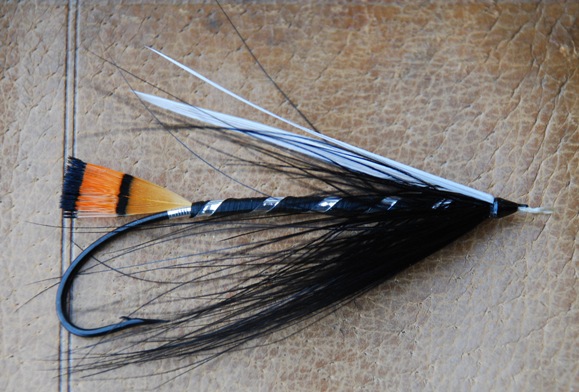
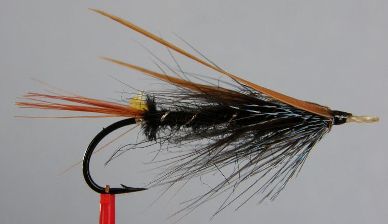
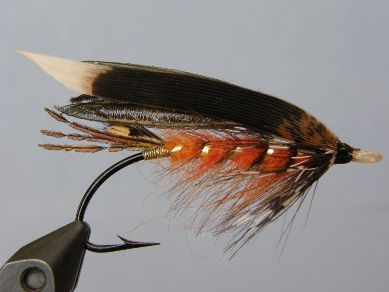
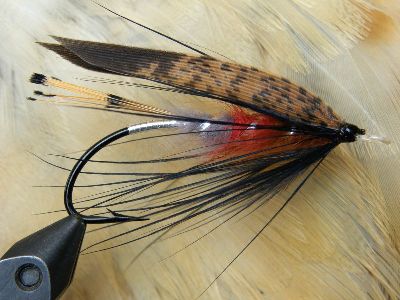
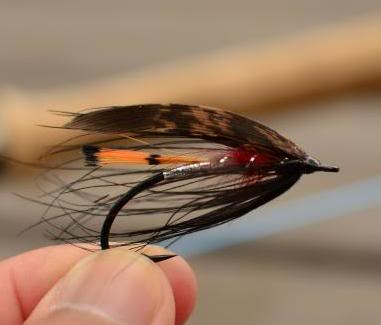
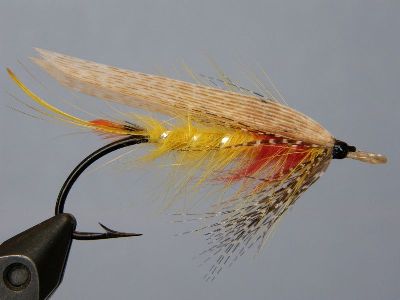
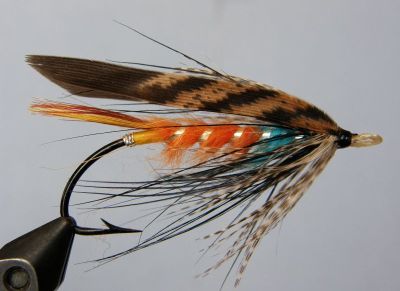
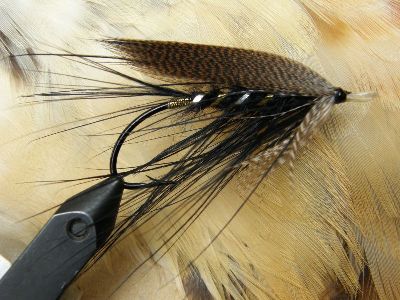
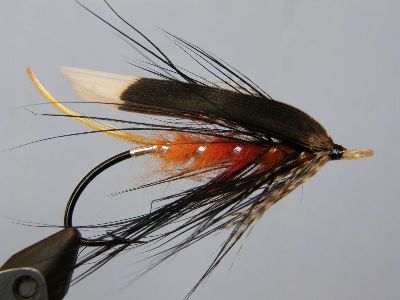
Lots on this page, including, Skier, Skirmisher, Skirrows Fancy, Snarehill, Stevenson, Tartan, Thunderer, Tilibouries, Tricolour, Vero, Wasp, Wattie Plants, Winnie, William Brown's Don flies, WM's Don flies, Yellow Parson. Scroll down to see 'em all. Skier WM Tag: Silver tinsel. Tail: A bunch of tippet, double and upright. Body: Black floss. Ribbed: Flat silver tinsel, 5 turns. Wings: Single strips of white turkey. Hackle: Black, half-way up body. Head: Black. Limericks, Nos. 5, 6, and 7.
I have also found from the Fishing Gazette in 1889
Murdoch is fishing for a large fish (in the Dee) and having difficultly hooking it – he is with the “Famous old gillie Red Donald” (Jiggling is moving the rod back and forwards in an attempt to impart life to the fly - today it has an unpleasant name on the Dee the "Norwegian XXXX") "We had tried him with the Silver Doctor, Green Peacock, Kelly, Sun fly, Silver Blue - all the bright day Clearwater flies we could think of. We had (it was every two hours or so) tried him with dull flies, biggish flies, wee flies. We had jiggled for him; sought to coax him; bullied him; done everything possible to put him up but – no, he would not come. Donald had fairly lost all hope of getting the “brute,” as he called him. It was now about seven o’clock and he had gone up to the lodge to see and get the two fish – which I didn’t care to have – packed to send to the railway station. His work over for the day, a big stump of a fellow employed in the fields came down just before Donald left, and with him, as the old gillie said, to carry my gaff and cleck the fish, I was left sitting on the seat at the style, waiting to see “that fish” – that obstinate fish – show himself once more. I hadn’t to wait long. By a quarter to eight o’clock he showed twice. It had now got a grey dull evening, and the wind had turned to the South East. I hesitated whether I would have another cast over “that fish” or not. I thought – well what’s the use? And then again why not when there is time? At last I resolved to give him another fly. I put on Donald’s famous “Skier,” a white-winged, white hackled fly, with a canary body, and down the bank through the boulders I went. I fished the nearside very carefully, then waded in a bit and cast further out, running off more line, till I got my fly to hing true on “that fish,” but no, no response. Was I defeated? No, I was not. I would give him yet another fly. I would put on a thumping big Peacock Heron. It would be a mouthful for him and no mistake. On this huge fly went, and soon it was over the place where “that fish” lay. There was a splash as it came across him in the quickest of the water. I saw nothing more but I knew that he or some other fish had risen. I gave another cast but no. I was a little excited. I fancied it was the big fish. I put on a slightly smaller Peacock Heron, and in five minutes more it was also over him. He came this time – it was “that fish.” The fly was into him I knew. He took it under the water, but the next moment a tremendous leap was performed, and away over to the other side he went, and was heading up stream. It was “that fish” clear enough." Skirmisher
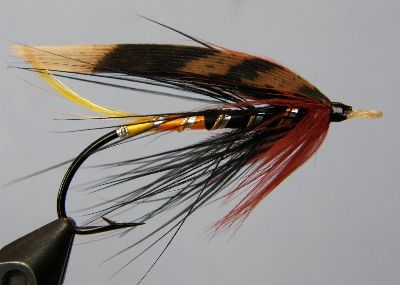
And here is one tied in hand by Adrian Cortes, ready to fish...
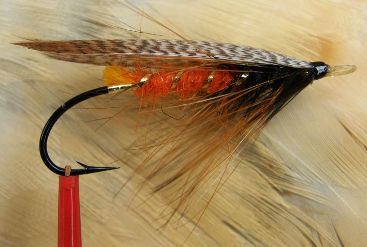
It clearly works! Kelson – The Salmon Fly, 1885 Tag: Silver twist and light yellow silk. Tail: Toucan, with two strips of ibis. Butt: Black herl. Body: Two turns of light dirty-orange silk, followed by dirty-orange seal’s fur, well picked out. Ribs: Silver tinsel (oval). Throat: Coch-a-bonddu hackle tinged in Bismark brown. Wings: Golden pheasant tail and peacock herl mixed in strands. Sides: Teal and ibis married. Horns: Blue macaw. Head: Black herl. Rivers: Hardy – Salmon Fishing, 1907 Tag: Silver tinsel; light yellow floss. Tail: Toucan; ibis. Butt: Black herl. Body: Two turns light dirty orange floss followed by orange seal’s fur. Ribs: Silver tinsel. Throat: Cock-a-bonddu tinged in Bismark brown. Wings: Golden pheasant tail; peacock herl. Sides: Teal, ibis. Horns: Blue macaw. Head: Black.
Skirrow's Fancy
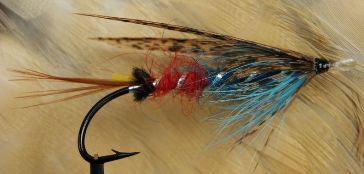
Tied in hand to fish with by Adrian Cortes Kelson – The Salmon Fly, 1885 Tag: Silver twist. Tail: A topping and Indian crow. Butt: Black herl. Body: Two turns of red seal’s fur, followed by blue seal’s fur. Ribs: Silver tinsel. Hackle: Blue hackle, from second turn. Throat: Jay. Wings: Double strips of teal. An old Tweed patter much sought after on the Hardy – Salmon Fishing, 1907 Tag: Silver tinsel. Tail: Topping; Indian crow. Butt: Black herl. Body: Two turns red seal’s fur followed by black seal’s fur. Ribs: Silver tinsel. Hackle: Blue. Throat: Jay Wings: Double strips of teal. Head: Black.
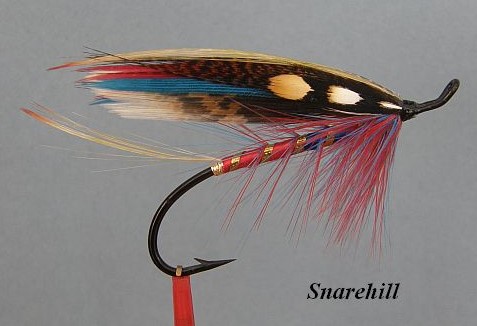
Snarehill
Frederick Hill – Salmon Fishing – The Greased Line on Tag: Oval gold Tail: Topping Body: Red and blue silk in equal parts, rib gold embossed tinsel. Hackle: Mixed dark blue and red. Wing: White tipped brown turkey, strips of blue and red swan, mallard, topping and jungle cock. Hills describes this fly as a large fly for the early part of the season in sizes 7/0 to No. 4.
Stevenson Kelson – The Salmon Fly, 1885 Tag: Silver twist and light blue silk. Tail: Topping, and strands if tippet. Butt: Black herl. Body: Two turns of orange silk, followed by orange seal’s fur. Ribs: Silver lace and silver tinsel. Hackle: Throat: Light blue hackle. Wings: Four double tippets (back to back) enveloping two extended Jungle; and a topping. Sides: Jungle. Horns: Blue macaw. Head: Black wool. Rivers: Tweed, Hardy – Salmon Fishing, 1907 Tag: Silver tinsel; light blue floss. Tail: Topping; tippet. Butt: Black herl. Body: Two turns of orange floss followed by orange seal’s fur. Ribs: Silver lace; silver tinsel. Hackle: Throat: Light blue. Wings: Four double tippets enveloping two extended jungle cock feathers; Topping. Sides: Jungle cock. Horns: Blue macaw. Head: Black wool.
Tartan
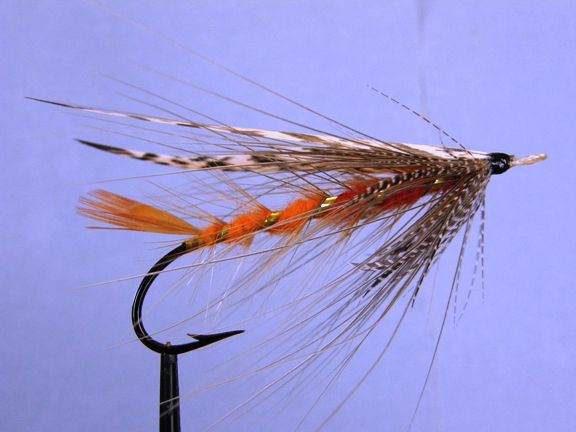
The Tartan to the Driffield Angler pattern by Bob Frandsen
The Modern Fisher or the Driffield Angler – Alexander Mackintosh 1806
OF SALMON FLIES.
These, for the spring season, must be made much larger, but not quite so gaudy as those used in summer, vie. let the hook be No. 1, the shank three indies or more in length, and small at the end, in order that the head of the fly may be made the neater: the feather for the wings, the darkish' brown speckled, from the turkey's tail, and mixed with about twelve harls from the peacock's tail, dividing them that there may be six in each wing; the next feathers for wings to these large flies, are kite, buzzard, bittern, and heron's wings. The body of the first fly, called the tartan-fly, is of four, five, or more different colours, yellow light blue, green, dark red, orange, and purple, and as many more colours as the fancy may lead the angler to; for the fork, or tails, use the dark mottled feather from behind the wild mallard's wings, and a black and red cock's hackle over the body, for the legs and head.
How to make the Tartan-fly, — Take three lengths of strong silkworm gut, properly twisted together, and having your silk well waxed (which must be of a light brown copper-colour) whip it round your gut six or seven times, about an inch or more, from the end, which will prevent the shank of the hook from galling it; then take the hook, and put the end of the shank nearly at the top of the silk, that the gut may be on the inside, and begin to whip the hook to it, but desist when you have gone about half a dozen rounds; then having a proper quantity of feather ready for the wings, take it and lay it on the back of the shank (keeping it close together, and as even as you can) with the right side next the hook, and the but-end downwards, leaving the other end to be (when turned back again) full as long as the hack; then go on with your silk and whip it round, your feather hook and gut six or eight times or sufficient to make it fast and with a pair of fine scissors cut away what remains of the but-end of the feather taking care not to hurt the gut, which must be opened and twisted round the shank of the hook as you go on with the wrapping which is to be continued till it nearly comes opposite the point of the hook (but you must cut off the ends of the gut before they come quite so low down if found too long;) next put on your strips of feather for the forks at the tail, with the fine points downwards, leaving them body exactly the same length, rather more than an inch long, and to stand open and make two laps round with the silk; then take the hackle (which must be ready prepared by stripping off the downy part at top, and cutting the feather across on each side near to the stem, about two or three tenths of an inch from the point, or by drawing the fibres back to prevent any of them from being bound down by the silk) and whip in the point of it two or three times round, leaving the largest end and gold hanging downwards, and the right uppermost, making one lap round between it and the fork, and one below all-round the bare hooky tight and close to the fork, and cut off the superfluous ends of it, if any remain in sight; then wax your silk afresh, and having your stuff for the body, all the different colours separate, the first of the brightest yellow hog's wool, and twist as much of it on the silk as will make four or five laps round the hook then as much more of dark red, of the same wool, twist on the silk and make five or six laps at the end of the yellow; then take as much of green and do it as before with five laps, and as much of light blue in the same way; as much dark orange done in the same way, and as much black as will bring you up to the wings, then fasten; take your needle and prick the body all round, and make it even and straight; then take your, gold plaiting, or twist, that hangs at the bend of the hook, and work it gradually upwards till you come close up to the feather for the wings, and fasten; then take your hackle and work it up neatly between the lappings of gold, till you come close to the but of the wings, make all fast by two or three laps, and if any of the fibres remain, strip them off from the stem; and untwisting the silk to its proper place, make two or three laps to fasten the hackle, and cut away what remains of the stem; then take the feather for the wings, which has lain back all this time, and turn it down towards the tail of the fly, and holding it down tightish, with the rest between your finger and thumb, having all the part of the hackle out of the way, whip it two or three times round with the silk just over the feather very tight, and then two or three laps dose above it; wax the silk again a little, and take a bit of copper-coloured mohair, and twill it thin on your silk and begin at the end of the hook and lap it neatly four or five times up to the back of the wings; make two or three nooses close to the wings and finish the operation with completing the head of the fly.
Here are 3 early Tartans, see below for a detail shot of the winging technique used by this dresser
Henry Wade – Halcyon – 1861 Wings: Dark speckled brown of turkey’s tail, mixed with twelve peacock’s herls. Body: A mix of every imaginable colour, forked with dark fibres of mallard’s feather. Hackles: Blood red. Rib: Gold twist. Shoulder: copper coloured mohair. Tip: Forks of dark fibres of mallard’s feather. The body of this fly is made with each colour separate, from yellow to black.
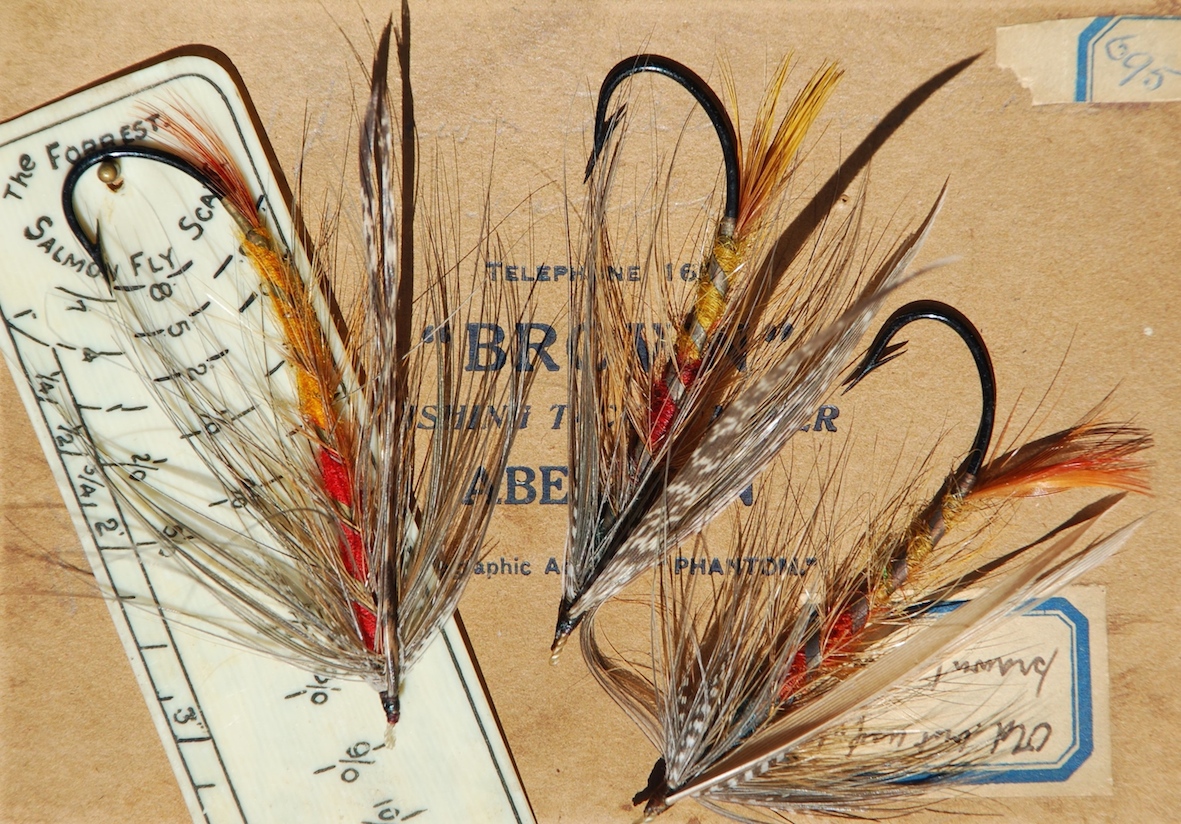
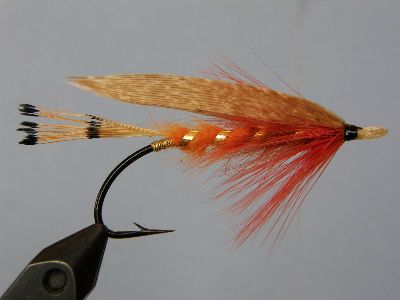
Tartan to the Francis Francis pattern tied by Bob Frandsen I love this description from Francis Francis Francis Francis – A book on Angling - 1867 Tag: Gold tinsel. Tail: Gold pheasant rump. Body: Half orange and half scarlet-red mohair laid on sparely, of course; broadish gold tinsel also spare. Hackle: First a stripped sandy-red cock’s hackle (that is, only one side of it to be used, the other being stripped off), and on top of this, the large blue-grey hackle or feather from the heron’s back and rump; the larger the better, they cannot be too large, as when the hackle is laid on, the fibres are expected to extend from the very head to the farthest bend of the hook. It is an awkward feather to lay on, as are all heron hackles, being very delicate. It should be tied in, to commence from as low down as it can be conveniently tied so as to leave enough for a good thick brush from the head. If in winding on the hackle, any of the red hackle fibres under it be wound in, they must be picked out afterwards with the needle, and put in their proper position. At the shoulder, a teal hackle of course. Wings: Two strips of silver-grey mottled turkey (the small mottled feather); these feathers are not easy to get. When the fly is finished, and before it is properly pressed down into shape, it looks like an enormous spider, or daddy longlegs; it certainly is a monstrosity, though, after all, not such a monstrosity as the Eagle. The Tartan is a strange looking fly and is rather a troublesome fly to dress. From Mr. Browns
WM Tag: Silver tinsel. Tail: red cock feather. Body: One turn orange, two turns blue, and three turns claret mohair. Ribbing: Silver tinsel, broad. Hackle: Grey heron (sparingly) down body. Wing: Distinctly marked black and white turkey. Head: Black. WM Tag: silver tinsel Tail: Golden pheasant, saddle feather. Body: Either orange and scarlet mohair in equal proportion, or two turns orange, two turns scarlet, and two turns blue mohair. Ribbing: gold tinsel. Hackle: Grey heron, partly down body. Shoulder: Teal. Wings: Mottled turkey of brownish shade. Head: Black.
Hardy – Salmon Fishing, 1907 Tag: Gold tinsel. Tail: Golden pheasant rump feather. Body: Orange and scarlet red mohair in equal parts. Ribs: Gold tinsel. Hackle: Blue, grey and red, using only one side of them. Wings: Two strips of silver grey mottled turkey. Head: Black.
Tricolour
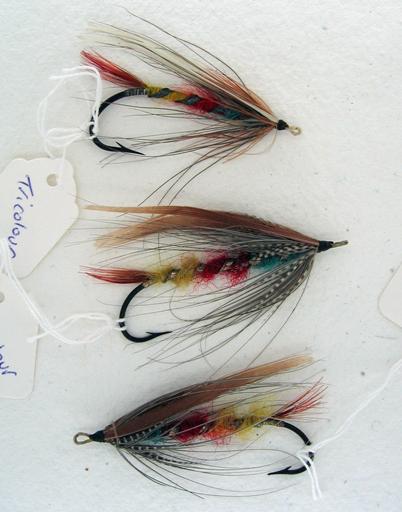
A trio of vintage Dee standards - note the order of body colours is different from the written patterns Walbran - The British Angler - 1889 Tag, Silver thread; tail, golden pheasant’s red rump feather. Body: A couple of turns each of yellow, light blue, and turkey red mohair (well picked our). Ribbed: Broad silver tinsel and silver twist. Hackle: Long grey heron’s (dressed full), with teal at shoulder, and also between the wings. Wings: Either white, sandy, or cream colour, according to fancy. Head: varnished. One of Mr. Murdoch’s Dee Patterns.
Kelson – The Salmon Fly, 1885 Tag: Silver twist. Tail: Red breast of the golden pheasant. Body: Yellow, light blue, and scarlet seal’s fur. Ribs: Silver lace and silver tinsel. Hackle: Natural grey heron, from blue fur. Throat: Widgeon (teal, large patterns) Wings: Two strips of plain, cinnamon turkey. A standard pattern on the Dee, which, when dressed with a red breast hackle of the golden pheasant and with two white (strips) wings, is known by the name of “The Killer”.
Hardy – Salmon Fishing, 1907 Tag: Silver tinsel. Tail: Red breast feather of golden pheasant. Body: Yellow, light blue and scarlet seal’s fur. Ribs: Silver lace; silver tinsel. Hackle: Grey heron. Throat: Widgeon. Wings: Two strips of plain cinnamon turkey. Head: Black Pryce-Tannatt - How to Dress Salmon Flies, 1914 Tag: Silver tinsel. Tail: A topping and the tip of a golden pheasant’s breast feather. Body: Pale yellow, light blue and scarlet seal’s fur in equal sections. Ribs: Flat silver tinsel and twist. Hackle: A grey heron’s hackle from third turn of tinsel. Throat: Teal. Wings: A pair of cinnamon turkey tail strips (set flat). Hook: 1½ to 3 inches.
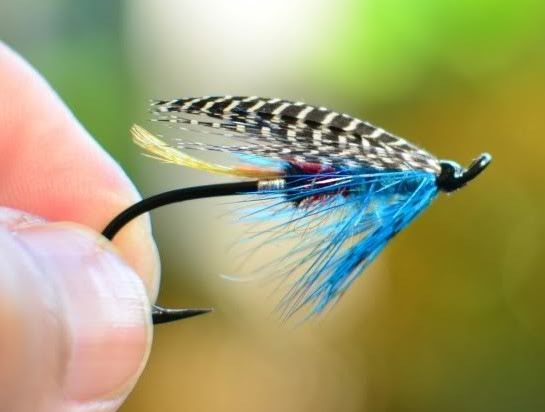
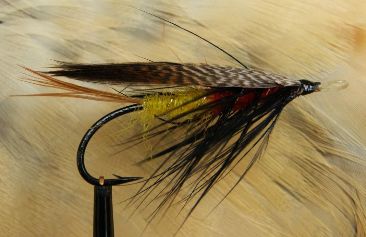
Vero WM Tag: Silver thread and yellow floss. Tail: A small topping. Butt: Black herl. Body: Blue (Peacock) silk floss. Ribbed: Silver twist – five turns. Wings: Double strips of mallard; topping over. Hackle: Magenta; well down body. Shoulder: A small quantity of teal. Head: Black. Double Limericks, 5, 6, and 7 in size. The parentage of this fly is claimed by one of our most experienced and skilled
Wasp
A fly for fishing tied by Guy Heard WM Tag: Silver tinsel Tail: Small topping Body: Yellow mohair well picked out Ribbed: Black twist, 5 turns Hackle: Cork-y-bondu Wings: Double strips of mallard Head: Black Sizes, 6, 7, and 8, suitable for salmon, grilse or sea trout WM describes this pattern as “an old
The Winnie
Tied by Australian Bob Frandsen
The William Brown “Don Flies” Francis Francis – A Book on Angling, 1867
The Don empts itself a very short distance from the FF Don Fly Number 1
Tag: Silver tinsel. Tail: A few fibers of gold pheasant rump and a small tuft of yellow crewel. But: Black ostrich herl. Body: Black pigs wool. Ribbed: Silver twist. Hackle: Black with blue jay on shoulder. Wings: Gled or Dun turkey strips. Size FF Don Fly Number 2
Tag: Silver tinsel. Tail: A few fibres of gold pheasant rump and a small tuft of yellow crewel. But: Black ostrich herl. Body: About two fifths dark red and three fifths dark blue pig. Hackle: (Only at shoulder) light blue, and over it a short grouse hackle. Wings: Strips of the red of dun turkey feather speckled with black. Size FF Don Fly Number 3 Tag: Gold tinsel. Tail: A small tuft of orange crewel. Body: Two thirds orange and one third black pig. Ribbed: Narrow gold tinsel. Hackle: (only half way down), a large coch y bondu hackle, with well marked centre. Wings: strips of grey mallard with brownish points. Size Also described as a standard for the Deveron. FF Don Fly Number 4 Tail: A few fibbers of gold pheasant rump. Body: Half yellow and half medium red pig’s wool. Ribbing: Gold twist. Hackle: Only half way down, a small black heron’s hackle, just long enough in the fibre to cover the point, and barb. Wings: Grey mallard with a trifle more brown at the tip than pattern 3. Size Also described as a standard for the Deveron. FF Don Fly Number 5 Tail: A small topping. Body: Purple claret pig’s wool. Ribbed: Silver twist. Hackle: Black heron dressed spare, and only on the shoulder, but longer in fibre than the bend of the hook. Wings: Two strips of gled or red turkey. Also described as a standard for the Deveron. FF Don Fly Number 6 Tag: Gold tinsel. Tail: A small bit of topping. Body: brown-orange mohair. Ribbed: Gold tinsel. Hackle: Blue heron’s hackle fibres to extend to about the bend of the hook. Wings: Two strips of bright speckled grey turkey. Size Also described as a standard for the Deveron.
The “WM” Don Flies WM
In the matter of flies the inference of a stranger, even an experienced angler, on visiting first the Don and then the Dee, would naturally be that for these rivers they must differ much in character and appearance. Two rivers running almost parallel for the greater part, and debouching within a couple of miles of each other, could not well be more dissimilar in general aspect. Yet, barring a few minor details, the flies found suitable for the one prove equally so for the other. Claret (fiery), orange, and black, in the order named, are the best WM Don Fly Number 1 (all the flies in this series are illustrated by flies tied by Bob Fransden on antique 3/0 Allcock hooks)
Tag: Fine gold thread and light blue floss. Tail: a topping, about an inch in length, and a small golden pheasant tippet. Butt: Black ostrich herl. Body: Yellow and black mohair, finely laid, one third yellow and two-thirds black. Ribbed: Silver twist. Hackle: Common cock – yellow down the yellow, black down the black part of the body, fibre longish. Shoulder: A long and full guinea-fowl hackle Wings: In strands, mottled turkey, yellowish dyed, ginger speckled turkey, mallard, pheasant and bustard, three strips of yellow swan, on either side and one on top, a large topping over all. Cheeks: Jungle. Head: Black herl. WM Don Fly Number 2
Tag: Silver twist and blue floss. Tail: A topping and Indian crow. Butt: Black ostrich herl. Body: One turn orange floss, three turns yellow mohair, one turn crimson mohair. Ribbed: Flat silver tinsel, broad and laid on pretty thickly. Wings: In strands, ginger speckled turkey, black and white striped turkey, pheasant, bustard and parrot, red, blue and yellow swan, powdered blue macaw, and a topping over all. Shoulder: Teal round shoulder in fair quantity. Cheeks: Blue chatterer. Head: Black herl. WM Don Fly Number 3 The above tied by Bob
A number 3 tied for fishing by Ardian Cortes
And the fish it caught Tag: Silver tinsel and pale green floss. Tail: Golden pheasant saddle feather, full and long. Body: Three turns blue and two turns orange mohair, well picked out. Ribbed: Narrow silver tinsel, exactly six turns. Wings: Mixed, ginger speckled turkey, yellow swan, bustard, pheasant, teal, and mallard. Sparse black heron hackle close to head. Shoulder: Teal Head: Black. WM Don Fly Number 4 Tag: Gold twist. Tail: Golden pheasant saddle feather and greenish herl. Body: one turn yellow, two turns green, and three turns scarlet mohair: flat gold tinsel, laid on pretty thickly. Hackle: Yellow hackle of longish fibber well down body. Wings: Light brow turkey. Shoulder: Guinea fowl. Head: Black WM Don Fly Number 5 Tag: Gold twist. Tail: A few fibbers greenish herl, and a couple of jungles. Body: Very dark orange mohair; flat gold tinsel. Wings: Strips of brown and black turkey, with white tips, speckled; between these about a dozen fibbers bronze peacock herl. Hackle: A coch-y-bonddu down body. Shoulder: Guinea fowl rather sparingly round shoulder. Head: Black. WM Don Fly Number 6 The above tied by Bob
This one tied by Adrian Cortes.. and put into action
William would have been proud ! Tag: Silver tinsel about a quarter of an inch in extent. Tail: Fibbers of golden pheasant tippet. Body: Mouse, red and dark brown mohair in equal proportions; Ribbing: Narrow silver tinsel three turns. Wings: Light brown turkey strips with black tips. Shoulder: Black heron hackle. Head: Black head. WM Don Fly Number 7
Tail: A small topping and Indian crow. Body: Three turns bright yellow and two turns red mohair. Ribbing: Narrow silver tinsel five turns. Wings: Sand coloured turkey strips. Hackle: Yellow cock hackle well down body. Shoulder: Teal. Head: Black. WM Don Fly Number 8 Tag: Silver tinsel and yellow floss. Tail: a mixture of golden pheasant rump and saddle feathers. Body: Three turns orange and two turns light blue mohair, well picked out. Ribbing: Flat medium silver tinsel. Wings: Brownish barred turkey strips with black tips. Hackle: Black heron close to head. Shoulder: Teal. Head: Black. WM Don Fly Number 9 Tag: Gold thread. Tail: A small quantity of black heron. Body: Black mohair. Ribbing: Silver and gold tinsel alternatively. Wings: Strips of mallard. Hackle: Very long black heron completely down body. Shoulder: Teal Head: Black. WM Don Fly Number 10 Tag: Silver tinsel. Tail: A small topping. Body: Two turns orange, one turn red, and two turns dark brown mohair, well picked out. Ribbing: Five turns flat medium silver tinsel. Wings: Two strips rich brown turkey with black bar and white tip. Hackle: Black heron from red mohair. Shoulder: Teal. Head: Black. WM Don Fly Number 11
Tag: Silver thread and yellow floss. Tail: A small topping. Body: orange and black floss – orange about quarter of an inch – the rest black. Ribbing: silver tinsel and gold flat worm. Wings: Two strips rich brown turkey with black bar and white tip. Hackle: Black heron halfway down the body rather sparingly. Shoulder: Claret hackle not very full. Head: Black. WM Don Fly Number 12 Tag: Gold thread. Tail: Fibbers of tippet longish and full. Body: Wings: Light brown turkey strips. Hackle: Red cock hackle half way down body and very full at shoulder. Head: Black.
Yellow Parson Kelson – The Salmon Fly, 1885 Tag: Silver twist and violet silk. Tail: A topping and tippet strands. Body: Two turns of yellow silk, followed by yellow seal’s fur. Ribs: Silver tinsel (oval). Hackle: Yellow hackle from silk. Throat: Scarlet hackle, veiled with two small toppings. Wings: Two tippets (back to back), a strip of summer duck on each side, and two toppings. Horns: Blue macaw. Cheeks: Chatterer. An old Usk fly, used also on the Thurso, Wye, and Don. Hardy – Salmon Fishing, 1907 Tag: Silver tinsel; violet floss. Tail: Topping; tippet. Body: Two turns of yellow floss followed by yellow seal’s fur. Hackle: Yellow. Throat: Scarlet and two toppings. Wings: Two tippets; summer duck and two toppings. Cheeks: Chatterer. Horns: Blue macaw. Head: Black.
Enjoyed it? Can you help? Improvements? Leave a message
|
 |
 |
 |
 |
 |
 |
 |
 |
 |
 |
 |
 |